Loose canvas distortions, paint loss and scratches are common results of paintings that have been subjected to smoke, age and mistreatment. But these are all correctable problems. The painting in this photo has discolored grimy varnish that is partially cleaned away revealing the original colors. Remember, cleaning is an aesthetic option. Not a preservation requirement, usually.
The decision of how to correct the dings/dents is always a tough decision for a client. There are two choices and two long term results:
1. locally flatten out the dent and it may go away and no longer be visible. However, with time, a spiderweb type cracking pattern will probably appear around the point of impact.
2. If you line the painting (give it a reinforcement backing) then the dent will go away and the cracking will not appear later on… but this is the more expensive option by a factor of about 6-8.
Filling the areas of paint loss (you can see two dings) and re-stretching the canvas is the only way to make the painting look like it hasn’t been beat up.
After all the conservation treatments, this painting will have clean brighter colors and the scratches and cracks will no longer be visible… and it should be “good to go” for a couple of more generations, with proper care and precautions.
Questions about conservation/restoration? Call us toll free at 888-704-7757
Questions about preparing your stuff for an earthquake or hurricane? Click on “Products” at the top of the page.
Questions about art and antique appraisals? Call Richard at (805) 895-5121
Questions about working with an insurance claim? Call us toll free at 888-704-7757
Also see: www.tipsforartcollectors.org
www.insurancepersonalpropertyassessment.com
What can you do at home or at the office to protect and save your artwork and collectibles from damage in an earthquake or hurricane?
Neil Cavuto thinks that an expert can predict an earthquake, for the first time, and in the article link at the end of this article, he lays out the reasons.
Washington and Oregon is being warned of a 9.0… but all of California is part of the “Ring of Fire.”
What can you do to prepare?! Well, here’s a hint: More people are damaged in an earthquake by stuff that’s flying around in the air rather than a building falling on them.
What could become a projectile in your home or office? Collectibles, glassware, figurines and ceramics, artwork, heirlooms, memorabilia?
Anchor these items down! See this quick video…
www.freeearthquakeinfo.org/museum-wax-package
We’ll send you out your purchase immediately!
Here’s Cavuto’s comments:
http://fxn.ws/gCgnyD
The Japanese Earthquake today makes our blood run cold for the devastation… but what does this earthquake news teach us about our potential for a “situation” where we live? This article addresses a niche expertise that you will NOT FIND ANYWHERE ELSE and is of extreme importance. Keep in mind as you read this article that it focuses on protecting, preserving and saving property that is historically, financially and emotional important to households and businesses. We do not write about health and safety issues, building structural problems, economic matters etc.
What do you cherish and fear losing in the next earthquake? Heirlooms, crystal, collectibles, family history, intellectual property? What items of value would impact your business continuity and how would these items, flying around in an earthquake, affect personal safety?!
Here is an earthquake fact: Notice in the photos of the earthquake damage that you see on the news and/or the Internet that not all homes, building etc are completely destroyed. In fact there is an epicenter that gets hit hard but even the buildings in the critical area get hit and missed. IT ALWAYS PAYS TO PREPARE in order to:
- Keep things from flying around in the air during the earthquake for personal safety
- Protect important historical items
- Save financially valuable items
- Protect and save emotionally valuable items
- Know ahead of time what will impact your business if you lose it.
Surprisingly, an easy, fast, do-it-yourself anchoring technique can save you in all of these five needs of being protected mentioned in the first paragraphs… in all of these problem areas… this will help you BIG TIME! http://www.tipsforartcollectors.org/museumwax-package
A recent news video on earthquakes stated that seismologist experts record over 27,000 earthquakes in the US each year! (most barely detectable but an indication of potential).
Even if you are safe after an earthquake, broken items like glassware, crystal, collectibles, ceramics can make it hazardous to move around and get things done. Not only will these broken items of value would impact your business continuity and personal safety… you will be anxious to talk to insurance adjuster later. So,
- Prepare ahead of time with an inventory of emotional, historical and financially valuable items
- Take photos
- Make copies of documents of ownership, authentication, appraisals etc.. and…
- Keep your copies in another city!
In the USA, there is an association called AIC-CERT that helps with responding to saving cultural property in disaster situations. “The Rapid Responders, AIC-CERT,are made up of dedicated professional conservators with whom I could trust my most precious items. They provide a huge service, much needed during community response efforts.”
For more information from AIC: An AIC-CERT brochure can be downloaded at http://bit.ly/AIC-CERT. You can also donate to support this invaluable service.
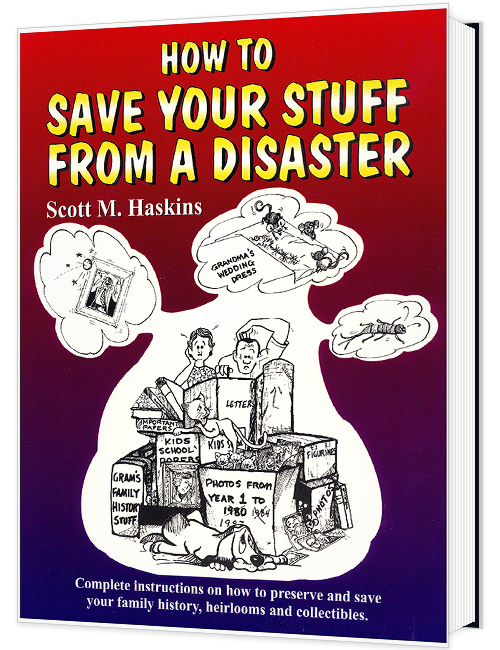
Scott M. Haskins has worked in both Europe and the U.S. as a professional conservator since 1975. He has years of experience planning for and responding after earthquakes, hurricanes, floods, mold, fire and everyday home accidents and is the author of “How to Save Your Stuff from a Disaster,” (http://www.saveyourstuffblog.com) a non-technical book with instructions on how to protect and save important documents, photos and other items not covered by insurance He wrote a booklet on “How To Respond After an Earthquake” of which the Bank of America Corporation distributed over 500,000 through their Human Resource Depts after the Northridge Earthquake.
Call for interview at 805 564 3438 or
e-mail at best_artdoc@yahoo.com
Facebook Pages at: “Save Your Stuff”
Twitter: “saveyourstuff”
Please give this article a THUMBS UP!

The varnish is discolored from grime and smoke as well from aging. When varnish yellows the original colors become muted and sometimes you may loose depth, whites turn yellow or brown, crisp blues turn a muddy green and purples turn brown. You can see that you loose contrast and depth of field.
By cleaning a painting you regain the brilliant colors and you see the image as the artist intended it to look like.
Questions about conservation/restoration? Call us toll free at 888-704-7757
Questions about preparing your stuff for an earthquake or hurricane? Click on “Products” at the top of the page.
Questions about art and antique appraisals? Call Richard at (805) 895-5121
Questions about working with an insurance claim? Call us toll free at 888-704-7757
Also see: www.tipsforartcollectors.org
www.insurancepersonalpropertyassessment.com
What can you do at home or at the office to protect and save your artwork and collectibles from damage in an earthquake or hurricane?
Go to www.saveyourstuff.com/museum-wax-package
The stains seen on this engraving are from mold that grew on the paper after it got went during Hurricane Katrina. Although the mold is dry and dead the stains from infestation are very disfiguring and will darken with time. The darker the mold stains that develop are the harder they are to remove.
Four different kinds of mold are visible in colors of black, red, yellow and brown. Blotchy acid stains probably transferred from poor framing and mounting materials. Numerous distortions and ripples are present as well. All of these conditions can be improved and removed; in fact we expect it to look different when we are done. We expect the cost to be $400.00 for just the conservation treatments. Framing will be extra.
Questions about conservation/restoration? Call us toll free at 888-704-7757
Questions about preparing your stuff for an earthquake or hurricane? Click on “Products” at the top of the page.
Questions about art and antique appraisals? Call Richard at (805) 895-5121
Questions about working with an insurance claim? Call us toll free at 888-704-7757
Also see: www.tipsforartcollectors.org
www.insurancepersonalpropertyassessment.com
What can you do at home or at the office to protect and save your artwork and collectibles from damage in an earthquake or hurricane?
Watercolors are a very sensitive delicate type of artwork and special precautions need to be taken. Some of the common problems with watercolors are the following:
1. Extensive fading is common. Use UV filtering glass (or Plexiglass) and hang them in low light locations.
2. Do not let them get wet as acids will migrate and stain and are usually permanent (see photo). They can be
touched out but cannot be removed safely.
3. If the paper is folded, broken or scratched it is very difficult to repair.
Questions about conservation/restoration? Call us toll free at 888-704-7757
Questions about preparing your stuff for an earthquake or hurricane? Click on “Products” at the top of the page.
Questions about art and antique appraisals? Call Richard at (805) 895-5121
Questions about working with an insurance claim? Call us toll free at 888-704-7757
Also see: www.tipsforartcollectors.org
www.insurancepersonalpropertyassessment.com
What can you do at home or at the office to protect and save your artwork and collectibles from damage in an earthquake or hurricane?
We are often asked why cracks and ridges in the paint form around the perimeter of the oil or acrylic painting on canvas as you can see in the photograph. The crack is usually located between two to three inches in from the painting and corresponds to the inside edge of the stretcher bars (strainer or wooden frame) over which the painting is stretched.
This damage is caused by the cheap quality and the poor design of the stretcher bars which is typical of these very common cheaply priced artist supplies.
There is nothing the owner can do about avoiding these cracks. Keeping the painting in a stable environment and not allowing anything to lean or put pressure on the front of the painting while in storage.
The only way to remove these types of cracks is by lining the painting the visibility of the cracks can also be minimized by adjusting the lighting of the artwork.
These cracks form regardless of the quality of the painting or the famous status of the artist. These cracks formed in a painting worth about $175,000.00.
Questions about conservation/restoration? Call us toll free at 888-704-7757
Questions about preparing your stuff for an earthquake or hurricane? Click on “Products” at the top of the page.
Questions about art and antique appraisals? Call Richard at (805) 895-5121
Questions about working with an insurance claim? Call us toll free at 888-704-7757
Also see: www.tipsforartcollectors.org
www.insurancepersonalpropertyassessment.com
What can you do at home or at the office to protect and save your artwork and collectibles from damage in an earthquake or hurricane?
The bull’s eye cracking pattern in this photograph is typical of oil and acrylic paintings that get hit, poked, leaned on, punctured or ripped. The cracking pattern does not show up immediately.
So when this painting was hit the owner probably looked at he point of impact and thought there was no problem because no damage was visible. Cracking patterns like this begin to show up within about five years and get worse with time.
Lining a painting is the only way to remove the evidence of this damage and is the only way to keep the damage from getting worse with time.
Questions about conservation/restoration? Call us toll free at 888-704-7757
Questions about preparing your stuff for an earthquake or hurricane? Click on “Products” at the top of the page.
Questions about art and antique appraisals? Call Richard at (805) 895-5121
Questions about working with an insurance claim? Call us toll free at 888-704-7757
Also see: www.tipsforartcollectors.org
www.insurancepersonalpropertyassessment.com
What can you do at home or at the office to protect and save your artwork and collectibles from damage in an earthquake or hurricane?
This Barbizon picture is typical of paintings from the end of the 1800s: canvas brittle usually very cracked.
This painting had a large piece broken out of the painting from being hit by a child’s toy. Normally this would have only caused a dent but because of the poor quality materials more extensive damage occurred. The lesson to be learned with this example is to be especially alert and careful when handling brittle artwork or if deciding to place it in high traffic areas.
As you can see in the photograph we are able to repair extensive damage like this to perfect condition. Often times homeowner policies will cover the damage if the item is an heirloom.
Questions about conservation/restoration? Call us toll free at 888-704-7757
Questions about preparing your stuff for an earthquake or hurricane? Click on “Products” at the top of the page.
Questions about art and antique appraisals? Call Richard at (805) 895-5121
Questions about working with an insurance claim? Call us toll free at 888-704-7757
Also see: www.tipsforartcollectors.org
www.insurancepersonalpropertyassessment.com
What can you do at home or at the office to protect and save your artwork and collectibles from damage in an earthquake or hurricane?